Textile Auxiliaries Chemicals for the Full Wet-Processing Chain
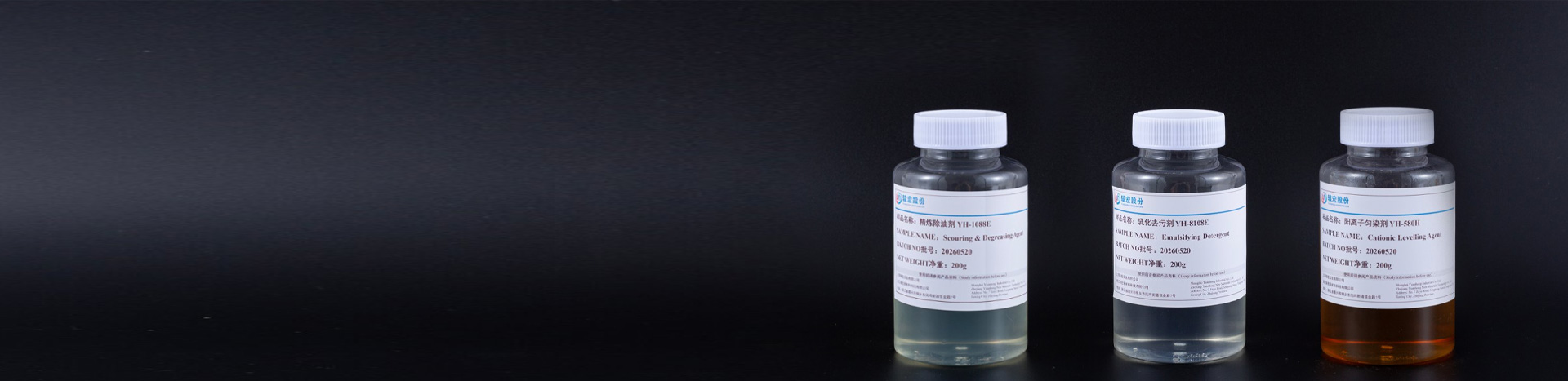
Shanghai Yuanhong Industrial Co., Ltd. is a Textile Auxiliaries Chemicals Company and China-based manufacturer serving textile fabrics, specialty yarns, apparel, leather, paper and semiconductor packaging chemicals. Our complete textile auxiliaries chemicals suppliers range covers pretreatment, dyeing, finishing, specialized niche chemicals and functional finishes, giving a wet-processing team one technical partner for a new line or an existing process audit.
The range is built around five families, with formulation work supported by an organic synthesis factory in Jiaxing, Zhejiang and an R&D team that collaborates with universities. We use the product family structure to match each auxiliary to the machine, fibre, water quality, shade target and fastness requirement rather than treating chemicals as interchangeable commodities.
Available Product Families
Each child category below is a working range, not a static list. We adjust concentration, ionic character and additive package when a customer's substrate requires it.
| Product Family |
Position in the Process |
Typical Technical Scope |
| Textile Pretreatment Auxiliaries |
First-stage fabric preparation |
Scouring, degreasing, wetting and penetrating, emulsifying detergents, reducing cleaning after dyeing. |
| Textile Dyeing Auxiliaries |
Dyebath control, shade repair, colour fastness |
One-bath scouring, leveling, dispersing, migration, dye fixing, shade correction and crease prevention. |
| Textile Finishing Auxiliaries |
Final handle, pile and surface effects |
Raising and sanding agents, water repellents, soft-touch finishing, stability during stentering and curing. |
| Specialized Textile Auxiliaries Chemical |
Niche process or performance problems |
High-stability dye fixing, nano-scale UV shielding, antimicrobial and anti-mildew finishes for premium fabrics. |
| Functional Textile Finishing Auxiliaries |
Protective end-use functions |
Broad-spectrum antimicrobial, nano UV protection, C6 and fluorine-free water repellents. |
Application Fit Across the Process Chain
Pretreatment is where absorbency, whiteness and uniformity are set. Our scouring and degreasing products remove spinning oils, weaving oils, waxes and natural impurities from cotton, chemical fibre blends and spandex fabrics while protecting fibre strength.
In dyeing, the key is controlling dye uptake and correcting defects without adding process steps. Leveling agents for microfibre, cationic leveling agents for acrylic, one-bath scouring and dye-fixing mending products let a dychouse improve reproducibility and reduce re-dyeing. Our shade-correction agents work at high temperature and high pressure to migrate disperse dye from high-concentration to low-concentration areas.
Finishing products are selected for the final fabric character. Raising agents for Holland velvet, sueded and loop-pile fabrics reduce friction and static to create dense, uniform piles, while water repellents and functional finishes are formulated for stability during stentering and curing.
Substrate and Material Considerations
- Cotton and regenerated fibres: scouring, wetting and rapid leveling products for high salt and metal-ion resistance.
- Polyester and microfibre: high-temperature leveling, dispersing and reducing cleaning agents with ultra-low foam.
- Nylon, spandex and stretch blends: degreasing agents for high-oil, heavy-silicone and high-density synthetic fabrics.
- Acrylic and wool blends: cationic-compatible leveling and retarding agents with migration behaviour.
- Velvet, sanded and loop-pile constructions: raising agents matched to fibre friction and pile uniformity.
Engineering Value and Custom Development
We develop custom Textile Auxiliaries Chemicals through end-to-end in-house R&D covering raw material evaluation, formulation design, process optimisation and quality control. The same team that improves an existing product can create a new one from the lab scale to mass production.
Our patents and "first-launch" products focus on home textiles, high-end apparel fabrics, raising and sanding specials, and microencapsulated coating materials. For a customer, this means a textile chemical can be tuned for a specific fibre, machine or compliance target instead of accepting a generic catalogue formula.
Quality, Sustainability and Production Support
We combine an organic synthesis factory in Zhejiang with a Shanghai Songjiang headquarters and branch offices in multiple regions. The company is committed to safety, environmental protection, ecology and health, and is actively seeking to join ZDHC for zero discharge of hazardous chemicals.
Our development roadmap prioritises low-foam, high-efficiency products that reduce energy and water consumption. This is also why the dyeing range includes eco-friendly rapid leveling agents, dye-fixing mending agents and fluorine-free water repellents for brands with restricted substance requirements.
Information We Use to Configure Your Solution
To prepare a product recommendation and quotation, we need the operating conditions around the process, not just the chemical name.
- Fibre composition, fabric construction and weight per square metre.
- Machine type: jet, overflow, jig, continuous washing range, pad-dry batch or stenter.
- Water hardness, pH and any recycled-water constraints.
- Target shade, colour fastness requirement and the dye/colorant system in use.
- Existing auxiliary chemistries and any ionic compatibility restrictions.
- Production volume, dosing method and available dwell or cure time.
- Regulatory or brand RSL requirements such as ZDHC, OEKO-TEX, REACH or restricted substance lists.
Frequently Asked Questions
What is the difference between pretreatment and dyeing auxiliaries?
Pretreatment auxiliaries make the fabric uniformly clean, absorbent and ready for dyeing. Dyeing auxiliaries act during the dye cycle to improve leveling, migration, dispersion, fixing or shade correction. In practice the two families are selected together for one-bath and high-efficiency processes.
Can you custom-develop an auxiliary for our fabric construction?
Yes. We support custom Textile Auxiliaries Chemicals development from formulation design through lab-scale trials and mass production. Share the fibre blend, machine profile and defect history so our R&D team can adjust the chemistry to your working point.
Are your products suitable for nylon-spandex and microfibre?
We offer degreasing agents developed for nylon-spandex and polyester-spandex stretch fabrics, plus high-temperature ultra-fine leveling agents for microfibre. Compatibility with batch and continuous lines is part of the selection criteria.
How do you confirm performance before full production?
Our R&D workflow includes raw material evaluation, formulation design, process optimisation and quality control. We can run a lab-scale trial to confirm the dosage, pH and temperature window before a new auxiliary is transferred to mass production.
Do you support eco-friendly formulations?
We are actively seeking to join ZDHC and focus a large part of the range on low-foam, high-efficiency and fluorochemical-reduced products. Eco-friendly leveling agents, dye-fixing mending agents and fluorine-free water repellents are available in the current range.



 English
 عربى